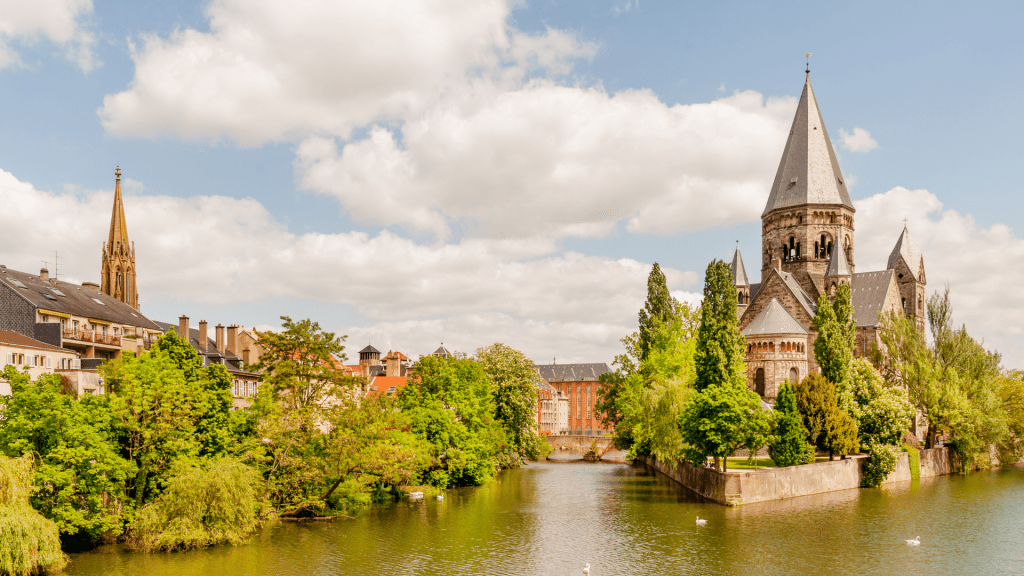
The most beautiful villages of Lorraine to discover from Nancy
Categories : Hotel, Discover Nancy, published on : 8/11/26
There are, Maurice Barrès said, "des lieux où souffle l'esprit". The writer from Lorraine had in mind a hill in the Saintois, a short distance from Nancy, which he made the setting of his most famous novel in 1913. A century later, that phrase could well sum up an entire aspect of the Lorraine countryside: villages perched above winding rivers, Enlightenment-era châteaux, fortified towns built upon the white gold of salt, and even the birthplace of Jeanne d'Arc. Nancy, with its Place Stanislas listed by UNESCO, its Art Nouveau façades and its cultural effervescence, is a destination in its own right. Yet the city is also an exceptional point of departure: within less than an hour's drive it opens onto a rural Lorraine, discreet and deeply endearing. Here are five villages, from the nearest to the most distant, to compose one or several days of excursion from the ducal capital.
For travellers who choose Nancy as their anchorage, the Hôtel Littéraire Stendhal constitutes a particularly apt address from which to explore the region. Situated in the heart of the historic centre, the hotel affords the enjoyment of Lorraine’s cultural riches while remaining close to the roads that lead to the villages and landscapes of the Saintois, the Saulnois and the Vosges. It is a way of making Nancy a true literary and heritage departure point, before setting out each day to discover a new territory.
Express getaways less than 30 minutes from Nancy
Liverdun, the medieval town suspended above the Moselle
About fifteen kilometres north of Nancy, some twenty‑five minutes' drive along the D90, Liverdun occupies one of the most photogenic sites in Meurthe‑et‑Moselle: a rocky promontory jutting into a wide bend of the Moselle, protected as a natural site since 1967. The town was, from the Middle Ages, the summer residence of the bishops of Toul, who established there a fortified stronghold of which the Porte Haute, remnants of the ramparts and a tangle of Renaissance lanes remain today.
During the Belle Époque, the great families of Nancy made it their favourite resort: they came to bathe in the Moselle, so much so that the village was nicknamed « Nancy Plage » or the “little Deauville” of Lorraine. It was in that era that the Château Corbin was built by the patron Eugène Corbin, a leading figure of the École de Nancy. Even today, the promenade along the Porte Haute affords one of the finest panoramas over the Moselle valley, and the Voie Verte running beside the river lends itself most agreeably to a stroll or a bicycle ride.
Liverdun has likewise earned a reputation far beyond its borders by virtue of its madeleine, whose traditional recipe has been handed down since the early twentieth century in a village bakery. Local legend maintains that it was precisely this madeleine that inspired Marcel Proust one of the most celebrated passages of French literature, that of involuntary memory in À la recherche du temps perdu. True or not, the anecdote aptly expresses the importance of gourmandise in the identity of these Lorraine villages, and it resonates all the more with those who stay in a hotel devoted to the letters.
After this first outing, the return to Nancy allows one to prolong that literary atmosphere at the Hôtel Littéraire Stendhal, where the journey continues through the writer’s world and his characters.
In practice: allow one and a half to two hours for a walk through the upper village, among ramparts, narrow streets and viewpoints over the Moselle. Ideal for a morning or late afternoon, as a complement to a day spent in Nancy.
Villages of Character and Legends of the Saintois (30 to 45 minutes)
Haroué, the « petit Chambord lorrain »
Approximately thirty kilometres south of Nancy, a mere half-hour's drive, the village of Haroué owes all its renown to its château, one of the most singular in the region. Erected between 1720 and 1729 by the architect Germain Boffrand for Marc de Beauvau-Craon, future Viceroy of Tuscany and Constable of Lorraine, the edifice has the particularity of incorporating the four towers and the water-filled moats of an earlier medieval castle, formerly belonging to the Marquis François de Bassompierre.
The château plays with the numbers of the calendar: 365 windows like the days of the year, 52 chimneys like the weeks, 12 towers like the months, and 4 bridges like the seasons. Inside, tapestries embroidered with threads of gold and period furnishings tell the story of a single family, the Beauvau-Craon, who still occupy part of the premises after three centuries, a continuity rare for a French château. The park, for its part, offers a dialogue between a classified jardin à la française and an English-style garden laid out later, in 1992.
The château may be visited (the estate has been managed by a public institution for forty years), but merely passing through this small village of the Saintois, calm and verdant, suffices to perceive how the Lorraine countryside can harbour great stories within modest bounds.
The hill of Sion-Vaudémont, where the spirit sighs
Thirty-five kilometres south of Nancy, a drive of some forty minutes, rises the hill of Sion-Vaudémont, the highest point of the Côtes de Moselle at 540 metres above sea level.
The site has been inhabited since the Bronze Age: the Celts, followed by the Romans, established places of worship there, before Christianity, from the 4th century onwards, made it a principal Marian pilgrimage site.
The sanctuary of Notre-Dame de Sion still receives pilgrims today, ten centuries after its origins.
It is this hill that Maurice Barrès, born in Charmes in the neighbouring Vosges, chose as the setting for his novel La Colline inspirée, published in 1913, which draws on the true story of the Baillard brothers, three priests who sought to revive the pilgrimage in the 19th century.
A monument in the form of a "lanterne des morts," conceived by the landscape architect Achille Duchêne and inaugurated in 1928, now honours the writer's memory on the site's highest point.
From there, the view embraces more than eighty-five villages of the Lorraine plateau, reaching to the first foothills of the Vosges on clear days. This linkage between literature and landscape echoes the spirit of the Hôtel Littéraire Stendhal, where a stay in Nancy likewise invites discovery of a region through the writers and works that have marked it.
At its feet, the medieval village of Vaudémont preserves the Tour de Brunehaut, a remnant of an 11th-century keep that once overlooked the entire fortified village.
Local legend ascribes to a princess of Vaudémont the origin of the « étoiles de Sion », small star-shaped marine fossils still found on the hill and reputed to be lucky charms.
Marsal, the fortified town of white gold
About thirty minutes' drive southeast of Nancy, in the Saulnois, the village of Marsal built its entire history upon a resource as precious as it was unexpected in the Lorraine soil: salt. From the Iron Age onward, natural salt springs were exploited there by the briquetage technique — clay vessels used to evaporate brine, then broken to recover the salt. The remains of this activity, known as the « Briquetage de la Seille », constitute a total volume of several million cubic metres spread over some ten kilometres, making it one of the most considerable Iron Age archaeological sites in Europe.
This wealth made Marsal a strategic prize hotly contested for centuries between the dukes of Lorraine, the bishops of Metz and the kings of France. The present fortifications, remodelled on the advice of the military engineer Vauban and completed in 1679, still encircle the village with bastions, ditches and glacis. The Porte de France, which now houses the departmental Salt Museum, elucidates how this little village could come to bear such weight in regional history. The collegiate church of Saint-Léger, partly built upon the layers of briquetage accumulated over the centuries, completes the visit.
In practice: these three villages of the Saintois and the Saulnois (Haroué, Sion-Vaudémont, Marsal) can easily be combined into a single day by car, forming a loop of approximately one hundred kilometres departing from Nancy.
A Vosges escape following in the footsteps of Joan of Arc
Domrémy-la-Pucelle, the village that altered the course of France's history
A little farther on, some an hour’s drive south of Nancy, in the north‑west of the Vosges, nestles one of France’s most history‑laden villages: Domrémy‑la‑Pucelle. It was here, about 1412, in a modest stone house by the Meuse, that Jeanne d'Arc was born, the daughter of peasant farmers, before becoming one of the most extraordinary figures in European history. The village, then simply called Domrémy, did not assume its present name until 1578, more than a century after the death of its most famous child — « la Pucelle », her contemporary sobriquet.
The family home, purchased by the département des Vosges in 1818 and classified as a monument historique as early as 1840, may be visited today: four rooms, including the chamber where Jeanne is said to have been born, allow one to appreciate the simplicity of this 15th‑century peasant way of life. Beside it, the interpretation centre « Visages de Jehanne », entirely redesigned in 2020, recounts the young woman's fate, from her Lorraine childhood to her military epic. On the neighbouring hill, the basilica of Bois‑Chenu, erected at the very end of the 19th century, marks the spot where Jeanne is believed to have heard her voices for the first time — a place suffused with a particular intensity, removed from any touristic bustle. From Jeanne d'Arc to Stendhal, Lorraine thus sustains a singular relationship with the great figures of French history and literature.
In practice: allow a good half‑day for the visit to the birthplace, the interpretation centre and the basilica. Domrémy‑la‑Pucelle lends itself particularly well to a combined excursion with Neufchâteau, about fifteen kilometres to the south, for those wishing to extend their day into the Vosges.
Organize one's route of Lorraine villages from Nancy
Five villages, three possible paces of discovery. For travellers staying at the Hôtel Littéraire Stendhal, situated in the heart of Nancy’s historic centre, this arrangement allows one to range easily by car while enjoying each evening the cultural atmosphere of the Lorraine capital. For a brief interlude during a stay in Nancy, Liverdun can be visited in half a day and combines effortlessly with a stroll through Nancy’s historic centre. For a full day, the trio Haroué – Sion-Vaudémont – Marsal forms a coherent loop across the Saintois and the Saulnois, between architectural heritage, legends and the gastronomy of salt. For a more ambitious excursion, Domrémy-la-Pucelle deserves a full half-day to itself, ideally coupled with an extra night to savour fully the surrounding Vosges.
In all cases, the car remains the most convenient means to explore the surroundings of Nancy: distances, ranging from fifteen to seventy kilometres, can be easily covered in a half-day return trip. Spring and summer, with their long days, offer the best conditions to fully enjoy the panoramas, notably the exceptional view from the hill of Sion-Vaudémont.
Of course, do not miss Nancy, which has so many things to make you discover.
From the Moselle loop at Liverdun to the voices heard by Jeanne d'Arc at Domrémy, these five villages trace another map of Lorraine, more intimate, scaled to a day's escape.
After such a route, nothing equals the return to Nancy’s historic heart, just steps from Place Stanislas, where Hôtel Littéraire Stendhal occupies the former palace of the primate of Lorraine.
A way to prolong the sojourn around literature, after having traversed the landscapes and villages that form Lorraine’s wealth.
The forty-one rooms, each devoted to a character from *Stendhal*'s novels, and the wellness area inspired by *Le Rouge et le Noir*, provide a stopover as literary as it is restful, allowing the voyage begun on the roads of the Saintois and the Vosges to continue in one’s chamber.
FAQ
Which village nearest to Nancy should one visit? Liverdun, some fifteen kilometres north of Nancy and about twenty‑five minutes by car, is the closest of the villages presented here. Its medieval town perched above the Moselle lends itself to a visit of a few hours.
Can one visit several Lorraine villages in a single day from Nancy? Yes. Haroué, the hill of Sion-Vaudémont and Marsal, all located thirty to forty-five minutes’ drive from Nancy and close to one another, can be combined in a single day by car.
How much time should one allow to visit Joan of Arc's birthplace in Domrémy-la-Pucelle?
Plan on half a day to visit the birthplace, the interpretation centre « Visages de Jehanne » and the Basilica of Bois-Chenu, located about an hour's drive south of Nancy.
Why is the hill of Sion-Vaudémont called “la colline inspirée”?
In reference to the novel of the same name published in 1913 by the Lorrain writer Maurice Barrès, which draws on the true story of the Baillard brothers and their attempt to revive the pilgrimage on this site occupied since the Bronze Age.
Which Lorraine village should one choose for a gourmand escape? Liverdun, famed for its traditional madeleine whose recipe has been passed down since the early twentieth century, and Marsal, whose entire history has been shaped by salt extraction, each offer a distinct and delectable entrée into Lorraine’s heritage.
SOURCES
Liverdun — Wikipedia: https://fr.wikipedia.org/wiki/Liverdun
Medieval city of Liverdun — Tourism Meurthe-et-Moselle: https://tourisme-meurtheetmoselle.fr/accueil/lessentiel/patrimoine/sites-monuments/751000731-cite-medievale-de-liverdun
Liverdun — Visit Grand Est : https://visitgrandest.com/villes/liverdun
The Moselle and Liverdun — France Bleu: https://www.francebleu.fr/emissions/c-est-lorrain-c-est-fin-bien/la-moselle-et-liverdun-un-tresor-lorrain-a-decouvrir-1000398
Château de Haroué, Lorraine gem — France Info : https://www.franceinfo.fr/culture/patrimoine/histoire/en-meurthe-et-moselle-le-chateau-de-haroue-joyau-lorrain-est-habite-par-la-meme-famille-depuis-300-ans_7594952.html
Château de Haroué — France 3 Régions : https://france3-regions.franceinfo.fr/grand-est/meurthe-et-moselle/nancy/le-chateau-d-haroue-un-bijou-du-patrimoine-prive-gere-par-un-etablissement-public-3218219.html
Château d'Haroué — Wikipedia: https://fr.wikipedia.org/wiki/Ch%C3%A2teau_d'Harou%C3%A9
Château de Haroué — Visit Grand Est : https://visitgrandest.com/chateau-de-haroue
Colline de Sion — Wikipédia : https://fr.wikipedia.org/wiki/Colline_de_Sion
Stroll to Sion, the Inspired Hill — Recoin.fr : https://www.recoin.fr/tourisme/la+colline+inspiree.htm
Medieval village of Vaudémont — Recoin.fr : https://www.recoin.fr/tourisme/village+medieval+de+vaudemont.htm
Colline de Sion-Vaudémont — About: https://www.collinedesion-vaudemont.fr/a-propos
The stronghold of Marsal — Lorraine Magazine: https://www.lorrainemag.com/sorties/la-place-forte-de-marsal/
Walk in Marsal — Lorraine Magazine : https://www.lorrainemag.com/sorties/balade-a-marsal/
Archaeological excavations of Marsal — Musée d'Archéologie nationale : https://musee-archeologienationale.fr/fouilles-archeologiques-de-marsal
Maison natale de Jeanne d'Arc — Department of the Vosges: https://www.domremy.fr/village-jeanne/maison-natale.html
Maison natale de Jeanne d'Arc — Visit Grand Est : https://visitgrandest.com/maison-natale-de-jeanne-darc
Domrémy-la-Pucelle — Vosges Tourism: https://vosges-tourisme.net/maison-jeanne-darc-domremy-la-pucelle/
Hôtel Littéraire Stendhal — official website: https://www.hotel-litteraire-stendhal.com/
Hôtel Littéraire Stendhal — Société des Hôtels Littéraires : https://www.hotelslitteraires.fr/en/our-hotels/hotel-litteraire-stendhal/
Written by Léa Geoffray


